Palmaria palmata, or dulse is reddish brown and thought of as a delicacy by many. It has doubtless been harvested for many centuries but, the earliest recording is 1400 years ago; St Columba and the monks of Iona ate it. Icelandic peoples also used it from early times. Now it is being cultivated and sold as a gourmet food. In Nova Scotia it is called Sea Parsley.
Dulse seaweed (Rhodymenia palmata) comes from a sea vegetable that has a fine distinct taste of the sea. Naturally mineral rich, our raw Organic Dulse powder can be easily included in practically any dish. Sprinkle it on entrees, soups and salads. Or add it to smoothies, teas and iced drinks. Our organic Dulse powder comes from the pristine and protected oceans off the coast of Canada.
Dulse is also a great natural source of Iodine / Potassium iodide (KI). Iodine is a chemical element essential for the production of thyroid hormones that regulate growth and metabolism. Iodine / Potassium iodide (KI), administered orally immediately after exposure to certain types of radiation, may be used to protect the thyroid from ingested radioactive iodine. But Potassium iodide (KI) / Iodine would only be effective if the radiation contains radioactive iodine. This natural form of Iodine from Dulse is absorbed by your body more slowly and safely than chemical or synthetic iodine. Further, Dulse helps promote an alkaline pH balance within the body and also boosts the immune system.
Dulse, contains around 10 – 20% protein and a whole slew of vitamins and minerals including, Alpha-carotene, beta-carotene, cobalt, lutein, niacin, phosphorus, riboflavin, selenium, silicon, sodium, tin, zeaxanthin, calcium, potassium, magnesium, iron, iodine, manganese, copper, chromium, zinc, vitamins A, B1, B2, B3, B6, B12, C, E and zinc. Unlike other seaweeds, it is relatively low in sodium.
Dulse powder is an excellent source of other phytochemicals and minerals. The complex polysaccharides in the herb make it a gentle alternative to psyllium or senna for the use of constipation. There are anecdotal reports that the daily use of a few flakes of Dulse can relieve cyclic mastalgia after two months. Dulse is eaten also with fish and butter, boiled with milk and rye flour, or as a relish. The gelatinous substance contained in Dulse is a thickening agent and imparts a reddish color to the food with which it is mixed.
In several traditions of European herbal medicine, Dulse powder was used to remove parasites, to relieve constipation and as a treatment for scurvy. Diets deficient in iodine increase the risk of retarded brain development in children (cretinism), mental slowness, high cholesterol, lethargy, fatigue, depression, weight gain, and goiter: a swelling of the thyroid gland in the neck.
Some possible traditional uses of Raw Organic Dulse Seaweed Powder may include:
● Ability to scavenge chemicals, drugs, heavy metals & radioisotopes throughout the body
● Great natural source of Iodine / Potassium iodide (KI)
● May Strengthen immunity
● One of the richest plant sources of calcium
● Removal of parasites
● More vitamin C than oranges
● May Relieve constipation
● Nurturing healthy heart vessels
● Aids in waste movement & digestion
● High mineral content, especially: iodine, calcium, iron, magnesium
● May Relieve cyclic mastalgia
● Anti-viral, anti-bacterial, anti-inflammatory properties
● Aids in Fighting scurvy
● Polysaccharides: important in the prevention of degenerative diseases
● Strengthens an underactive thyroid
● Excellent source of bioavailable iron
● May play a role in lowering risk of estrogen-related problems
● Cholesterol-lowering effects
● Antiviral, anticoagulant, & antithrombotic properties
● Contains fucoidans which may have anti-inflammatory benefits
● Natural source of the mineral vanadium which appears to play a multi-faceted role in regulation of carbohydrate metabolism & blood sugar






















SANE Eating For Kids, SANE Pregnancy, and The Facts About Childhood Obesity
Table of Contents
How Do I Make Setpoint Lowering SANE Meals for My Whole Family?
Some of the most common questions I get asked about eating SANE to lower your setpoint weight is how it impacts kids… and more generally… how your whole family eats.
Great new! No more making a separate meal for yourself while the rest of your family eats food they actually enjoy. SANE meals are family-friendly – on two levels. First, you and your entire family already eat and love a lot of SANE foods. There’s likely, however, a good amount of inSANE food also in the mix. So your strategy now is to simply to eat so much of the SANE food that you are too full for the setpoint elevating inSANEity.
You still make the foods your family knows and loves, and now you simply add simple SANE Substitutions for the inSANE foods. On taco Tuesday, have taco shells and add crispy romaine lettuce “shells” option. On spaghetti night, serve your favorite meat sauce over wheat pasta and also set a bowl of zoodles (zucchini noodles) out. We call this technique “modular meals” and it is great for gradually transitioning your family to SANE eating, or for situations when you need to cater to several different types of eaters. Your Expert Coaches in the Premium SANE Program can provide a lot more help here.
Second, SANE meals are the healthiest way to eat for everyone in your family: children, teens, adults, older adults, and anyone else. Think about it like this: How could eating food that prevents over eating (Satiety) while optimizing your hormones (Aggression) and giving you most nutrition per calorie (Nutrition) without packing on body fat (Efficiency), not be healthy for everyone?
One quick anecdote about how profoundly SANE can impact your health. For years, my wife and I postponed trying to start a family until I was 35 and she was 36. Our doctors told us the fact that we both work over 70 hours per week, our age, and how long my wife was on hormonal birth control, that it was very unlikely we’d be able to conceive regardless of how “healthy” we both claimed to be. We tried to get pregnant for the first time on November 26th, 2017. We conceived our first child on November 27th, 2017.
My wife and I 100% practice what we preach; we are #SANE4Life (which you’ll learn more about in a few chapters). We were overjoyed that despite what all the doctors told us, our choice to be #SANE4Life seems to have enabled us to beat the odds for creating life. SANE eating is simply the best way to live; and possibly even the best way to create life 😉
Starting SANE Childhood Obesity Prevention
Did my wife continue to eat SANE during her pregnancy? Absolutely. Providing optimal nutrition to children (whether in or out of the womb), is nothing short of a moral imperative considering what’s happening with the childhood obesity epidemic. SANE is not only fine for children, it’s even more important for children. When we feed our kids (or grandkids, nieces, nephews, or any little ones we care for) SANEly, we:
Give them the abundant nutrition their growing bodies need.
Your kids require more nutrition than you do. Water-, fiber-, and protein-rich SANE foods – contain more nutrition per calorie than any other foods, making this plan ideal for your children. They are still growing, so they need optimal nutrition from the most essential vitamins, minerals, proteins, and fats possible. There is no richer source of these than SANE meals.
Give them calories without giving them pre-diabetes, weight problems, or heart disease.
Growing children need a lot of calories. In the traditional western diet these calories come from sugars, starches and process fats that make them pre-diabetic, overweight, and prone to heart disease later in life. In fact, the most perverted part of the western diet is that “children’s food” is defined by food high in sugars, starches, and processed fats. Think sugary cereal, processed meats, fried everything, cheese on everything, sugar soaked everything. WHAT?!
Want to know the worst possible “food” for any human to eat – let alone humans who need the most nutrition – look at a “kid’s menu.” There is a better way. It is easy, inexpensive, and delicious to supply children with all the calories they’d ever need from wholefood fats (this applies to the athletes in your family too). You can do this deliciously by serving more SANE desserts or simply by adding cocoa/ cacao, coconut, coconut milk, nut butters, avocado, flax seeds, or chia seeds to smoothies.
Give children stable energy and the ability to focus and behave naturally.
Starches and sweets are dramatically more Aggressive than SANE foods. They release a short burst of energy into the body. This causes a brief energy high followed by longer-lasting lethargy. Still developing mentally and emotionally, children are doubly affected by these highs and lows; that is why they start bouncing off the walls and have a hard time concentrating after eating starches and sweets. Giving a child a soda and asking them to then “behave” is literally like someone giving you a line of cocaine and then asking you to “behave.”
SANE eating – which naturally reduces sugar and starch consumption – can go a long way toward supporting a child’s overall body and brain health. It has even been “prescribed” to help kids with ADHD (attention deficit hyperactivity disorder) because it ensures a slow and steady release of energy, increases the nutritional quality of the diet, and enables optimal mood and behavior. Yes, sometimes a “farmacy” can be even more effective – and certainly it has fewer side effects — than a pharmacy.
Set them up for success now and later.
Warning: These are going to be a tough couple of paragraphs, but you’ve been lied to long enough, so here’s two scientifically proven truths that may change the way you look at the way kids eat forever.
I could rant about this for hours but consider only this: Why are we so rightly vigilant about protecting children from smoking and second-hand smoke? Because we know it causes permanent health damage. Now consider the two facts about childhood obesity we just covered. Being overweight as a child causes permanent health damage AND permanent psychological damage. So why is it not only ok, but encouraged, that our schools serve our children processed sweets, starches, and fats? Could you imagine if there was a cigarette vending machine in a grade school? Crazy! Smoking causes permanent health damage. But that same school has vending machines packed with inSANE nonsense that not only causes permanent health damage, but also profound permanent psychological damage.
Why SANE Childhood Obesity Prevention?
Please join me in helping our country and world see that encouraging our children to put things into their body that permanently harms them physically and emotionally is tragic. It won’t be easy, and we won’t be able to turn the tide against childhood obesity overnight, but together, we can reverse the fact that today’s children are the first generation in recent history to have a lower life expectancy than us. We can to better. And now, armed with the facts, I’m confident we will.
Ready To Start Your Personalized SANE Plan to Lower Your Setpoint Weight?
Find out which Premium Wellness Program is the perfect fit for your goals, budget, and body. If you are ready to begin, click the button below to lower your Setpoint Weight and enjoy permanent weight loss… guaranteed!
SANE Smoothie: Blueberry Raspberry Bliss
Table of Contents
Source: 99 SANE Certified Green Smoothies Vol. 1
SANEScoring & Servings
TIP: You can learn more about SANE Servings Sizes & Scoring at the upcoming free Flat-Belly Hormones Masterclass.
Ingredients
TIP: Can’t find some of these ingredients at your local grocery store? Have them delivered quickly and easily by visiting your SANE Superfoods Store.
Directions
Remember that eating MORE deep green veggies is likely the single most belly-fat-burning and energy-boosting change you can make to your diet.
Until it becomes a habit, please give yourself permission to focus 100% of your wellness effort on eating (and drinking 🙂 ) double-digit servings of non-starchy veggies daily.
I promise that this one simple change will do more for your health, happiness, and slimness than all the other confusing and conflicting “tips” out there put together!
Gratefully and SANEly,

Jonathan Bailor
SANE Founder & NYTimes Bestselling Author
Notes
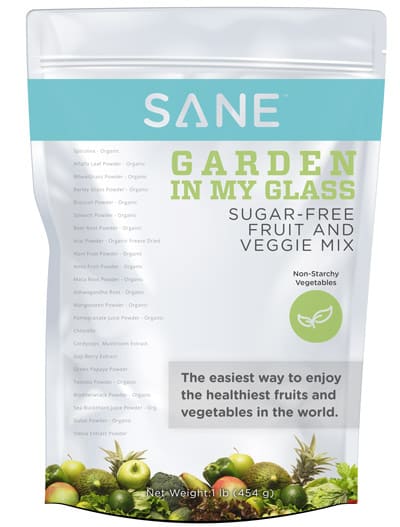
*You can add two additional serving of Non-Starchy Vegetables in place of the two tablespoons of Garden in My Glass. If you do not add more veggies and you do not add Garden in My Glass, track only two servings of Non-Starchy Vegetables per smoothie (instead of four servings).
**Only add protein if the smoothie is your entire meal. Vegetarians can use 6 TBSP of Clean Pea Protein (instead of Clean Whey Protein).
***To minimize sugar content, reduce fruit (other than lemon) and increase All Natural Slimming Sugar Substitute. If fruit is reduced by half or more, no Low-Fructose Fruit servings should be tracked. Due to their extremely low sugar content, lemons should not be reduced and do not need to be tracked.
Ready To Try a Personalized SANE Plan to Lower Your Setpoint Weight and Become Naturally Thin?
Find out which Premium Weight Loss Program is the perfect fit for your goals, budget, and body. If you are ready to begin, click the button below to lower your Setpoint Weight and enjoy permanent weight loss… guaranteed!
Key Takeaways
Table of Contents
Click pics below to easily pin & share
Ready To Try a Personalized SANE Plan to Lower Your Setpoint Weight and Become Naturally Thin?
Find out which Premium Weight Loss Program is the perfect fit for your goals, budget, and body. If you are ready to begin, click the button below to lower your Setpoint Weight and enjoy permanent weight loss… guaranteed!
Real-Life Insights and Takaways
SANE Soundbites
Scroll up to pin and share the sexy infographic versions of these 😉
Read the Transcript
Jonathan: All right. Kathy asks: I have the whey and cocoa powder and other items that are not necessarily clean, is it okay to use those until I get products in the SANE store? Yes, Kathy. So, that’s a great question. So, I will—just for what it’s worth, just to give you a little bit of context. There is quite a few people that are not actually able to make some of the live calls. So, because of that however I want to make sure these are super valuable for them. So, that’s why sometimes we have to give—I want to make sure I get to some of the questions that were written in because for folks that can’t make the calls they can still write in their questions and then see the session recording afterwards.
However, I love the interaction. So, I’m going to balance that, but Kathy, you asked the—yes, so, if you have things like whey and cocoa powder and other items that aren’t necessarily clean is it okay to use those or do you need to—are they going to destroy your efforts? So, this is a very great, specific question with an awesome specific answer and then also general learnings we can take away from it. So, the short answer is unless it’s just complete garbage, which I don’t think it is, like if it was Nestle Quick for example, which isn’t really cocoa powder. So, it’s probably something maybe like a Hershey’s cocoa powder that you might have, you know if it was Nestle, Nestle Quick I’d say throw that away because that’s not even cocoa powder that’s just sugar. But if it’s just general store bought stuff which is going to be reasonable SANE, hey, that’s not going to just completely ruin your efforts. And I want to make a quick general point here which is I would really encourage everybody, and this is really, really important. To think of your metabolic system a little bit like your immune system. Now, what do I mean by that? So, the way your immune system works is not that—so, your immune system is resilient, right. Like if you get a cold or if you get exposed to a virus or bacteria your immune system, if your immune system itself is healthy will bring your back. Right. That’s the job of your immune system and that’s why diseases such as HIV or AIDS are so terrifying because they attack your immune system itself.
So, why am I saying this? Well, also, for example if we were to say, “Hey is it okay to ever have any viruses or any bacteria enter your immune system?” Well, absolutely. I mean, that’s what you immune system is for. Life, we can never be perfect, we can never completely avoid sort of any of those disease causing agents, but we have to make sure we have a strong immune system, so that if we do exposed to something which is less than ideal we can come back from it. That’s the same thing, that’s the same mindset we want to have when it comes to our metabolism. So, your metabolism—we talk about the set point. We talk about it’s an established system and we talk about how when your set point is elevated or when your sink is clogged your body’s essentially fighting to keep you heavy. So, you can think of having a compromised metabolism like having a compromised immune system. So, when someone’s immune system’s compromised even like the slightest little thing can cause life threatening problems. But, when you have a strong immune system if you get a little bit of virus or bacteria, hey, you know you’ll bounce back in a week, you’ll bounce back in two weeks. You want to make sure you don’t intentionally expose yourself. Like you don’t want to have anyone coughing in your face, but you’re not worried if just a little bit gets in there. The same thing applies to your metabolism. Once we heal it from the inside, once we make sure you have a safe and strong metabolism a little bit of exposure to things that aren’t perfect for a lack of better terms, is really just going to be like water off a duck’s back.
And a good example of this is actually children. So, sometimes we think, unfortunately, and our society tells us—hey, you know, kids, if you look at a children’s menu, it’s so sad and it’s heartbreaking because it’s essentially a litany of inSANity. In some ways the definition of children’s food is that which is packed with processed nonsense fats and sugar and salt. I mean, of children’s menu or children’s cereal, if you think about it, those are the least SANE items in the world and we’re told by big food that that’s okay. I mean, they’re kids. Their bodies can handle it. And that’s really—that’s not at all true. I mean, it does the same level of damage if not more damage to children than it does to adults, but one of the reasons we don’t see it doing as much damage as immediately to children is a child’s metabolism is fresh. It hasn’t gone through cycles of yo-yo dieting, it hasn’t been exposed to a toxic food environments for 40, 50, 60 years. So, if a child gets exposed to consistent low doses of inSANE foods it’s going to have potentially less of a visible or immediate impact on them than it would an adult, not because it’s any less bad for them, but just because you know, their immune system, their metabolic immune system hasn’t been, let’s say you know, beaten down as long. Now, unfortunately that’s of course, we’re seeing nowadays that that’s not necessarily true in the sense that even though a child’s metabolism is fresh, you know it’s fresh the toxics stuff that’s being put into their bodies by schools and by food manufacturers is overwhelming them.
But, the macro point here, Kathy, to answer you question, is if you think about for example, maybe some whey and some cocoa powder that you got from your grocery store from G&C or something like that as being you know, not completely toxic, but something that’s suboptimally SANE, if you’re working to heal your metabolism you know, that’s just going to be like just a little bit of like a cold bug and getting into your immune system and as long as we heal the system itself it’s going to roll right off. So, is it great? No. Is it going to really help you? No. Is going to completely derail your efforts? No. And please, another good thing to keep in mind is there is really nothing you can do in one day—and man, this is a really important point actually, there is nothing you can do in one day that is going to completely derail your efforts. And I think that’s actually really important. Maybe even write that down like even on your worst day or our most inSANE day nothing you did that day ruins everything. Your health doesn’t work that way. So, by way of analogy, it’s really easy to lose all of your money in one day, right. If you look at the financial meltdown that happened a little while a lot of people lost all of their investment, or all of their 401-K, all of their retirement in one day.
Now, when it comes to our fat metabolism system, when it comes to neurological inflammation, when it comes to our hormones and our gut there is nothing that we can do in one day that just completely destroys that. That’s not how that biological system works. It’s not either/or. So, we’ve got to always remember to be kind to ourselves. Right. Like if something happens, you go to a party, you go a little inSANE. Look, it happened, you learn from it, you’re going to do your best to not let it happen again. But, the worst thing is not actually being inSANE in that moment. The worst thing would be to let that isolated event contaminate your lower case SANity. Like, it happened. Like, if you’re an athlete, you had a bad game, it’s cool. You know what? You know what the most important thing is that we learn from it and that we move on. So, whether it’s store bought whey, store bought cocoa powder, whether it’s a meal out with friends or whether it’s really anything in life in general I would urge you to give yourself permission to learn from that event, to make a commitment that it will never happen again or you will do everything in your power not to let it happen again, but to never let shame or guilt contaminate you. Because that’s hey, more than anything you’re going to find in processed foods, more than anything you’re going to find in that whey or that cocoa powder you bought from the store, Kathy, and every other member of the SANE family that’s on this session or watching it, none of that will derail your SANity even to close to as much as shame or guilt or feeling any of those sort of sensations towards yourself will.
Okay. Like please, don’t do that. All right. I mean, you’re here. Kathy, the fact that you even had that thought is a huge win. It’s a huge, huge win. Okay. So, lots of stuff there. Hopefully that was helpful. Let’s see what else we’ve got here. Yes. Salad in a jar. All right. Rebecca, I know we’ve got some great questions about how to get veggies in on the go. For sure we got some questions actually written in on that one, so we’ll cover that. Okay. Cool. Beans, all right. So, I’m going to jump in some of the questions that were written in here. So, the first question we’ve got here is how do you set goals to shift from inSANE to SANE? Add one vegetable per day, cut inSANE foods one per week? What do I change first? How fast do I go?
Hey, that’s an awesome question. So, thank you very much, that’s great. The general question here is how do I work my way into this? How do I set SANE goals? Well, let me first answer that by saying what I really don’t want you to do. And this is after years and years of experience in working with thousands and thousands and thousands of people and reading a lot of research. So, two things. First is do not set a goal, and I know that this is going to sound strange, but I’ll explain why, I want you to if at all possible, to give yourself permission to set what’s called process goals rather than results goals. Let me explain that. With process goal your goal is exactly what is illustrated in this excellent question here. Like, “I am going to eat one more serving of vegetables this week than it did last week.” And the reason that’s an awesome goal is because you can control it. As much as you can control anything in life. Right. You can control whether or not you eat one more vegetable. You cannot control, no matter how much calorie counters want to make you think otherwise—right. Oh, eat seven less calories per day and you’ll lose exactly this much weight in this much time. Which all of us have tried. It’s never worked because that’s not how your body works.
You cannot control how quickly your metabolism heals. You can control how much you stack the deck in the favor of your metabolism healing, but actually how long it takes your metabolism to heal is unfortunately not up to us. Right. If it was totally up to us I can imagine hey, you know, you get the flu going, back to that immune system analogy, [inaudible 00:21:24], “I want to be better tomorrow.” But, unfortunately I can’t do that, but what I can do is of course, get some rest. I can drink some tea, I can make sure that I’m taking some vitamin C. I can do all the process steps so that I facilitate that result, but my goal is always on the process. And please, like that, if you didn’t do—if you got nothing else from this call or this session, that in it of itself, focusing on process goals rather than results goals is so important. I mean, that’s such ancient wisdom. That’s not my idea. That’s from long, long ago. Right. There is a famous quote, I’m paraphrasing this from the Buddha, who says, “As long as you’re facing in the right direction just keep walking and eventually you’ll get there.” Obviously I kind of screwed it up a little bit, but the point is that you know, just take another step, take another step, and take another step. Eventually you will get there. And so, process versus results goal super important, but what are those process goals? Look, let’s keep this really, really simple. Really, really simple. Because it can be simple. To focus—I mean, it’s—it can be simple. It doesn’t necessarily mean it’s easy, but it can be simpler than it’s been made out to be. Vegetable process goal: track, whether it’s using the SANE app, whether it’s using the SANE paper tracker how many servings of vegetables you ate on average this week. Next week take it up by one or two. That’s an epic goal. Another epic process goal, if you’re not drinking SANE green smoothies, start, maybe not every day, but if last week you did zero maybe this week you do one. Next week you do two.
Write that down. You know, I went from one to two. I went from two to three. And that in it of itself is so encouraging because we’re here for the long-term. Right. If you’re on these calls that means you’re here SANE Ignite lifetime. Right. So, those small process steps make such a difference over time. And that’s what we want, right. We’ve all yo-yoed in the short-term. We want those long-term results. Nutrient dense protein. Same thing, just think of it in terms of servings. You know, maybe last week you did a great job of getting your nutrient dense proteins in at lunch and dinner, but you struggled with breakfast. So, maybe you say next week I’m going to make sure I get it in at breakfast. And just something simple. Right. Focus on the food groups. What can I do this week in terms of process for my vegetables? What can I do this week in terms of what one thing can I do this week in terms of process for my proteins? What one thing can I do in terms of my whole food fats? Now, what one thing can I do this week to maybe stand and move my body more? What one thing can I do this week to get more familiar with eccentric exercise? What one thing can I do this week to maybe get a little bit more sleep? What one thing can I do this week to drink a little bit more water? Or to swap more water and green tea instead of any sort of inSANE beverage?
But, that like, it’s hard to put into words how deeply empowering taking on the mindset of small process goals and having that success and sharing that success—like, even if it’s not perfect. Write that down in the SANE support group, in your journal, “This week I’m going to focus on this one process goal, this one process goal, this one process goal.” Three things most. And let us know how you did. Holy moly. Those gradual steps in the three main food groups, and then when it comes to movement I think that in it of itself is going to be hugely powerful. And then maybe in terms of recipes like this one, this week can you find one SANE recipe that you enjoy so much that you—it’s just something it’s a go to recipe. You say, “Oh, my gosh. One recipe in a week that’s nothing.” But, think about it. If you just keep that up at the end of the year, one year, right, we’re all going to be here for longer than a year, after one year you would have 52 recipes that you’ve mastered that you love, that maybe you know your family loves. Fifty-two. I mean, how many different recipes do we make over the course of a month today? Imagine if a year from now you had 52 perfectly SANE recipes that you and your family love. Does that sound crazy? Well, if you found one per week consistently you’ve got it, but that’s not what we’re told to do, right. We’re like I’ll do everything right now versus do this one thing consistently. Do that one process thing consistently and holy moly, like the Buddha said, and I butchered, that’s facing the right direction and if you just keep walking oh, my goodness. SANE, you will be super SANE. You’ll be super SANE.
All right. Let’s see. Here we go. Yay, the [inaudible 00:26:22]. I love this. All right. We got here, got some good chat coming in here. Thank you so much, Kate. And Rebecca, Kathy. Kate’s got some good questions. Epigenetics, yes, Kate, I have done some research on epigenetics. If you have a specific question, please feel free to type it there in the chat box. I’d be happy to help. Will changing my eating help me with Hashimoto’s? What’s up, Alison? And I love how you spell your name. That is a fantastic way to spell your name.
Yes, it will absolutely help you with Hashimoto’s. Anything that is going to increase the nutrient density of your diet and reduce the inflammation that you encourage is going to help with any malady. And we talked about this in the last session, but there is no medical condition—like so, if you think about disease, one way to think of disease is the body not being in its desired state. So, we have vitamins and minerals and proteins and fats that we call essential. Essential amino acids, essential fatty acids, vitamins and minerals are essential. If we don’t eat enough of them we get things like scurvy, rickets so on and so forth. If you don’t eat enough B vitamins your spinal column deteriorates. Not good. Why am I saying these things? Well, disease is caused by a breakdown of something in the body. Now, it only makes sense that if we give the body an abundance of that which it needs to thrive and to heal itself—because remember, the only way we ever heal is the body healing itself. That’s not like woo-woo mystical crystals. That’s science. That’s eastern medicine, western medicine, common sense. The only way disease ever goes away is if the body heals itself. Like that’s what putting a bone in a cast does. It allows the body to heal itself. The flu only goes away if the body heals itself by providing your body with the foods that give it the most of what it needs and in fact, an abundance of those things. You’re not eating less of everything, you’re eating more SANE things, so much so that you’re crowding out the inSANE things.
Any disease of the body will get better. It has to. We’re giving the body more of what it needs to heal itself and less of what causes it to breakdown in the first place. That’s going to help and that’s going to help globally and really, really powerfully. And that’s why this is so much different than just counting calories and eating less because eating less just gives you less of everything. You don’t need less of everything. You need more of good things. So much so that you’re too full for the inSANE nonsense. So, hopefully that’s really helpful.
Why is whole wheat bad for us? Great question. So, let’s keep in mind here that whenever we’re talking about food, food is a zero sum game. So, what I mean by that? It’s kind of an economic term. It’s when we eat one thing we’re not eating another thing. Which I know sounds a little bit stupid, but it’s actually important to think about. So, if we put a bunch of whole grains on our plate by definition we are not putting something else on our plate. So, it’s taking up space. Now, when it comes to is something good for us or is something healthier, is something SANE that’s really like—as you know, we have the spectrum. Right, we have the non-starchy vegetables on end of the spectrum, we have liquid sugar on the other end of the spectrum. Whenever we say is something good or bad for us what we’re really asking is like is this better than that or is this better than everything else I could be eating right now? So, for example is whole wheat bad for us relative to sugar? No, absolutely not. And in fact, the reason that have heard that whole grains are good for us is because they are better for us than refined grains. If you had to choose between eating Wonder Bread and eating bread that was made from Einkorn wheat which is, the Einkorn and amaranth wheat is the wheat that existed in Biblical times versus the dwarf mutant wheat that we have today which is the totally different species of wheat. It’s got like 42 chromosomes whereas the wheat of Biblical times was back in the teens, like I think it had 12 or 14 chromosome. Totally different—it’s a totally different plant. It’s literarily like apples and oranges. So, amaranth wheat compared to dwarf mutant wheat, totally different thing.
So, if we’re eating whole wheat, even dwarf wheat instead of eating sugar that’s a good choice, that’s better for us. Much like eating—smoking one pack of cigarettes per day is better for us than smoking two, but the key thing to keep in mind is just like smoking one pack of cigarettes per day versus smoking two doesn’t make smoking one pack of cigarettes just objectively good for us. Especially when we could be breathing in even cleaner air. So, let’s go back to the whole grains. What people, a lot of people use whole grains for is to fill themselves up. So, often what happens is whole grains are used to crowd out vegetables. So, they’re just like rolls or filler or rice. I mean, they’re usually just things to fill you up. Now, when it comes to filling ourselves up we now know, oh, my goodness, from a hormonal healing perspective and just from a satisfaction perspective and health and a fat loss perspective, whole food fats they are satisfying and they are so hormonally healthy for us. And they also don’t contain any sort of inflammatory substances. Like for example, there is like amylopectin A is a very addictive substance that’s found in whole wheat. Whole grains can cause gut permeability issues because they have a lot of various substances that can irritate gut bacteria. This is why you hear so much about celiac disease. This is why you hear so much about a gluten intolerance. There is just a lot of things in whole grains that are not nearly as beneficial for us as some of the other foods that we can be eating.
So, it’s not like, “Oh, my Gosh, the reason we have obesity epidemic is because people are eating whole grains.” No, no. I mean, that’s not the reason we have an obesity epidemic, but the reason whole grains are not considered SANE, in addition to being relatively low satiety and low in nutrition and aggression—the factors that contribute to SANity is just because man, I’d so much rather you’re eating your vegetables. And actually I had—I interviewed one of the, someone who used to be the head, she was the speaker, the public face for the like the national dietetic association or something, some big organization. And I just asked her, I asked her point blank, you know, “If you had—if a person was eating whole grains in place of vegetables would you recommend that?” And of course, not. Right. There is nothing that is unique about whole grains that we can’t get in greater abundance in vegetables and low sugar fruits as well was like without all the like gluten and other stuff. Like there is no amylopectin A or gluten in kale.
So, whole grains, it’s not like, “Oh, whole grains!” It’s just that whole grains do some damaging things to quite a few people. They can stimulate appetite, they could cause a lot of insulin to get released in your body which can contribute to pre-diabetes. They can make you hungrier rather than satisfying you, but most importantly, often they’re preventing you from eating SANEr foods. And I want you to eat so much of the good stuff that you’re just too full for things that are less SANE. So, hopefully that is helpful. All right. Let’s see here. Let me catch up on a little bit of the chat. All right. Good stuff. Oh, goodness, now there’s lots of chat. Julia and Fran and Allison. Julia, I haven’t seen you on chat before. Welcome. Julia is not being shy. I like that. All right. Let’s go. Tell me your problems are going to be sugar and gluten [inaudible 00:34:40] anything inSANE. Never felt so great. Oh, thank you so much, Fran. That’s good stuff. Fran. Fran is just dropping positivity in here, I love it. I love it.
Salt. Alison, do we need to limit salt because to me that’s what makes veggies taste good. Good news! Salt has been given a bad rep. So, here’s the situation with salt. The reason salt has been given—when you think salt you probably don’t think super healthy. I don’t know what you think, but you probably don’t think super healthy. The bottom line is that salt is definitely an issue when you’re eating inSANE foods. When you’re eating inSANE foods what you’ll find is that the amount of salt in processed food—right, salt is a preservative. So, when you take soy and corn and wheat and other processed mono crops and you strip out all the nutrients you got to make them taste like something because you know what? Soy by itself with everything stripped away just does not taste good, neither does wheat, neither does corn. You got to do something with it. What you can do with it to give it a really stable shelf life and to make it taste good for very little money? You pump it full of trans fats because trans fats stay shelved, stay stable. You pump it full of a huge amount of salt and you pump it full of sugar. Right. If you read—what’s the guy’s name? I forget his name. But, the title of the book is Fat, Sugar, and Salt. And talking about the three major weapons of the processed food industry. And of course, we all know that it’s not that like fat is bad, it’s the fat found in processed food is bad. Same thing with salt.
Salt when used like—when we would normally use it is not going to be bad. The way you would naturally and normally use salt, not bad, but when we put our trust and our health frankly and our lives in the hands of companies whose only interest—they’re not evil, right. They’re not evil, but Nestlé’s job, right, people who own stock in Nestle are not interested in the blood pressure or other people. They’re interested in making money. That’s their business. Right. That’s not evil, right. We all have jobs and we’re all able to use computers because businesses exist. So, there’s nothing wrong with business. It’s just that we have to understand that processed food manufacturers are not in the business of our health, they’re in the business of making food that costs them very little to sell, that they could charge a lot for and that tastes good. Adding a heck of a lot of salt, adding a heck of a lot of a sugar and adding a heck of a lot of unnatural fats causes that. And it kills us. So, just like everything else if you do it the way nature intended it, it’s all good. It’s all good. So, yes, if you are just sprinkling some sea salt or my favorite is pink Himalayan salt that has a wonderful flavor to it, it’s got some essential minerals in it, that’s a great way to help with the veggies. And as a general rule of thumb anything within reason, within reason that you can do to get yourself and your family to eat more vegetables, boom, it’s worth it.
So, bacon is not particularly SANE to just eat strips and strips of bacon, but to use bacon as a seasoning for vegetables do it, do it. Whatever you can do to get that nutrition into your body do it. Salt has been given an overly bad rep in general. Number one, number two, you will not overdo it with salt if you don’t consume inSANE processed food because you would never—just like for example, right, soda has 11-15 teaspoons of sugar in 12 ounces which is ridiculous. If you were going to make yourself a beverage, even if you were going to sweeten it you would never sit there for yourself or for someone you love and say, “I’m going to make my five year old the beverage here. Here, let me get some sugar. One, two, three, four, five, six, seven, eight, nine, ten, eleven, thirteen, fourteen, fifteen.” You would never do that, ever. But, food manufacturers will. So, as long as we stay away from the processed nonsense we’ll be all right in terms of that.
Ready To Try a Personalized SANE Plan to Lower Your Setpoint Weight and Become Naturally Thin?
Find out which Premium Weight Loss Program is the perfect fit for your goals, budget, and body. If you are ready to begin, click the button below to lower your Setpoint Weight and enjoy permanent weight loss… guaranteed!
Key Takeaways
Table of Contents
Click pics below to easily pin & share
Ready To Try a Personalized SANE Plan to Lower Your Setpoint Weight and Become Naturally Thin?
Find out which Premium Weight Loss Program is the perfect fit for your goals, budget, and body. If you are ready to begin, click the button below to lower your Setpoint Weight and enjoy permanent weight loss… guaranteed!
Real-Life Insights and Takaways
SANE Soundbites
Scroll up to pin and share the sexy infographic versions of these 😉
Read the Transcript
Jonathan: All right. Kathy asks: I have the whey and cocoa powder and other items that are not necessarily clean, is it okay to use those until I get products in the SANE store? Yes, Kathy. So, that’s a great question. So, I will—just for what it’s worth, just to give you a little bit of context. There is quite a few people that are not actually able to make some of the live calls. So, because of that however I want to make sure these are super valuable for them. So, that’s why sometimes we have to give—I want to make sure I get to some of the questions that were written in because for folks that can’t make the calls they can still write in their questions and then see the session recording afterwards.
However, I love the interaction. So, I’m going to balance that, but Kathy, you asked the—yes, so, if you have things like whey and cocoa powder and other items that aren’t necessarily clean is it okay to use those or do you need to—are they going to destroy your efforts? So, this is a very great, specific question with an awesome specific answer and then also general learnings we can take away from it. So, the short answer is unless it’s just complete garbage, which I don’t think it is, like if it was Nestle Quick for example, which isn’t really cocoa powder. So, it’s probably something maybe like a Hershey’s cocoa powder that you might have, you know if it was Nestle, Nestle Quick I’d say throw that away because that’s not even cocoa powder that’s just sugar. But if it’s just general store bought stuff which is going to be reasonable SANE, hey, that’s not going to just completely ruin your efforts. And I want to make a quick general point here which is I would really encourage everybody, and this is really, really important. To think of your metabolic system a little bit like your immune system. Now, what do I mean by that? So, the way your immune system works is not that—so, your immune system is resilient, right. Like if you get a cold or if you get exposed to a virus or bacteria your immune system, if your immune system itself is healthy will bring your back. Right. That’s the job of your immune system and that’s why diseases such as HIV or AIDS are so terrifying because they attack your immune system itself.
So, why am I saying this? Well, also, for example if we were to say, “Hey is it okay to ever have any viruses or any bacteria enter your immune system?” Well, absolutely. I mean, that’s what you immune system is for. Life, we can never be perfect, we can never completely avoid sort of any of those disease causing agents, but we have to make sure we have a strong immune system, so that if we do exposed to something which is less than ideal we can come back from it. That’s the same thing, that’s the same mindset we want to have when it comes to our metabolism. So, your metabolism—we talk about the set point. We talk about it’s an established system and we talk about how when your set point is elevated or when your sink is clogged your body’s essentially fighting to keep you heavy. So, you can think of having a compromised metabolism like having a compromised immune system. So, when someone’s immune system’s compromised even like the slightest little thing can cause life threatening problems. But, when you have a strong immune system if you get a little bit of virus or bacteria, hey, you know you’ll bounce back in a week, you’ll bounce back in two weeks. You want to make sure you don’t intentionally expose yourself. Like you don’t want to have anyone coughing in your face, but you’re not worried if just a little bit gets in there. The same thing applies to your metabolism. Once we heal it from the inside, once we make sure you have a safe and strong metabolism a little bit of exposure to things that aren’t perfect for a lack of better terms, is really just going to be like water off a duck’s back.
And a good example of this is actually children. So, sometimes we think, unfortunately, and our society tells us—hey, you know, kids, if you look at a children’s menu, it’s so sad and it’s heartbreaking because it’s essentially a litany of inSANity. In some ways the definition of children’s food is that which is packed with processed nonsense fats and sugar and salt. I mean, of children’s menu or children’s cereal, if you think about it, those are the least SANE items in the world and we’re told by big food that that’s okay. I mean, they’re kids. Their bodies can handle it. And that’s really—that’s not at all true. I mean, it does the same level of damage if not more damage to children than it does to adults, but one of the reasons we don’t see it doing as much damage as immediately to children is a child’s metabolism is fresh. It hasn’t gone through cycles of yo-yo dieting, it hasn’t been exposed to a toxic food environments for 40, 50, 60 years. So, if a child gets exposed to consistent low doses of inSANE foods it’s going to have potentially less of a visible or immediate impact on them than it would an adult, not because it’s any less bad for them, but just because you know, their immune system, their metabolic immune system hasn’t been, let’s say you know, beaten down as long. Now, unfortunately that’s of course, we’re seeing nowadays that that’s not necessarily true in the sense that even though a child’s metabolism is fresh, you know it’s fresh the toxics stuff that’s being put into their bodies by schools and by food manufacturers is overwhelming them.
But, the macro point here, Kathy, to answer you question, is if you think about for example, maybe some whey and some cocoa powder that you got from your grocery store from G&C or something like that as being you know, not completely toxic, but something that’s suboptimally SANE, if you’re working to heal your metabolism you know, that’s just going to be like just a little bit of like a cold bug and getting into your immune system and as long as we heal the system itself it’s going to roll right off. So, is it great? No. Is it going to really help you? No. Is going to completely derail your efforts? No. And please, another good thing to keep in mind is there is really nothing you can do in one day—and man, this is a really important point actually, there is nothing you can do in one day that is going to completely derail your efforts. And I think that’s actually really important. Maybe even write that down like even on your worst day or our most inSANE day nothing you did that day ruins everything. Your health doesn’t work that way. So, by way of analogy, it’s really easy to lose all of your money in one day, right. If you look at the financial meltdown that happened a little while a lot of people lost all of their investment, or all of their 401-K, all of their retirement in one day.
Now, when it comes to our fat metabolism system, when it comes to neurological inflammation, when it comes to our hormones and our gut there is nothing that we can do in one day that just completely destroys that. That’s not how that biological system works. It’s not either/or. So, we’ve got to always remember to be kind to ourselves. Right. Like if something happens, you go to a party, you go a little inSANE. Look, it happened, you learn from it, you’re going to do your best to not let it happen again. But, the worst thing is not actually being inSANE in that moment. The worst thing would be to let that isolated event contaminate your lower case SANity. Like, it happened. Like, if you’re an athlete, you had a bad game, it’s cool. You know what? You know what the most important thing is that we learn from it and that we move on. So, whether it’s store bought whey, store bought cocoa powder, whether it’s a meal out with friends or whether it’s really anything in life in general I would urge you to give yourself permission to learn from that event, to make a commitment that it will never happen again or you will do everything in your power not to let it happen again, but to never let shame or guilt contaminate you. Because that’s hey, more than anything you’re going to find in processed foods, more than anything you’re going to find in that whey or that cocoa powder you bought from the store, Kathy, and every other member of the SANE family that’s on this session or watching it, none of that will derail your SANity even to close to as much as shame or guilt or feeling any of those sort of sensations towards yourself will.
Okay. Like please, don’t do that. All right. I mean, you’re here. Kathy, the fact that you even had that thought is a huge win. It’s a huge, huge win. Okay. So, lots of stuff there. Hopefully that was helpful. Let’s see what else we’ve got here. Yes. Salad in a jar. All right. Rebecca, I know we’ve got some great questions about how to get veggies in on the go. For sure we got some questions actually written in on that one, so we’ll cover that. Okay. Cool. Beans, all right. So, I’m going to jump in some of the questions that were written in here. So, the first question we’ve got here is how do you set goals to shift from inSANE to SANE? Add one vegetable per day, cut inSANE foods one per week? What do I change first? How fast do I go?
Hey, that’s an awesome question. So, thank you very much, that’s great. The general question here is how do I work my way into this? How do I set SANE goals? Well, let me first answer that by saying what I really don’t want you to do. And this is after years and years of experience in working with thousands and thousands and thousands of people and reading a lot of research. So, two things. First is do not set a goal, and I know that this is going to sound strange, but I’ll explain why, I want you to if at all possible, to give yourself permission to set what’s called process goals rather than results goals. Let me explain that. With process goal your goal is exactly what is illustrated in this excellent question here. Like, “I am going to eat one more serving of vegetables this week than it did last week.” And the reason that’s an awesome goal is because you can control it. As much as you can control anything in life. Right. You can control whether or not you eat one more vegetable. You cannot control, no matter how much calorie counters want to make you think otherwise—right. Oh, eat seven less calories per day and you’ll lose exactly this much weight in this much time. Which all of us have tried. It’s never worked because that’s not how your body works.
You cannot control how quickly your metabolism heals. You can control how much you stack the deck in the favor of your metabolism healing, but actually how long it takes your metabolism to heal is unfortunately not up to us. Right. If it was totally up to us I can imagine hey, you know, you get the flu going, back to that immune system analogy, [inaudible 00:21:24], “I want to be better tomorrow.” But, unfortunately I can’t do that, but what I can do is of course, get some rest. I can drink some tea, I can make sure that I’m taking some vitamin C. I can do all the process steps so that I facilitate that result, but my goal is always on the process. And please, like that, if you didn’t do—if you got nothing else from this call or this session, that in it of itself, focusing on process goals rather than results goals is so important. I mean, that’s such ancient wisdom. That’s not my idea. That’s from long, long ago. Right. There is a famous quote, I’m paraphrasing this from the Buddha, who says, “As long as you’re facing in the right direction just keep walking and eventually you’ll get there.” Obviously I kind of screwed it up a little bit, but the point is that you know, just take another step, take another step, and take another step. Eventually you will get there. And so, process versus results goal super important, but what are those process goals? Look, let’s keep this really, really simple. Really, really simple. Because it can be simple. To focus—I mean, it’s—it can be simple. It doesn’t necessarily mean it’s easy, but it can be simpler than it’s been made out to be. Vegetable process goal: track, whether it’s using the SANE app, whether it’s using the SANE paper tracker how many servings of vegetables you ate on average this week. Next week take it up by one or two. That’s an epic goal. Another epic process goal, if you’re not drinking SANE green smoothies, start, maybe not every day, but if last week you did zero maybe this week you do one. Next week you do two.
Write that down. You know, I went from one to two. I went from two to three. And that in it of itself is so encouraging because we’re here for the long-term. Right. If you’re on these calls that means you’re here SANE Ignite lifetime. Right. So, those small process steps make such a difference over time. And that’s what we want, right. We’ve all yo-yoed in the short-term. We want those long-term results. Nutrient dense protein. Same thing, just think of it in terms of servings. You know, maybe last week you did a great job of getting your nutrient dense proteins in at lunch and dinner, but you struggled with breakfast. So, maybe you say next week I’m going to make sure I get it in at breakfast. And just something simple. Right. Focus on the food groups. What can I do this week in terms of process for my vegetables? What can I do this week in terms of what one thing can I do this week in terms of process for my proteins? What one thing can I do in terms of my whole food fats? Now, what one thing can I do this week to maybe stand and move my body more? What one thing can I do this week to get more familiar with eccentric exercise? What one thing can I do this week to maybe get a little bit more sleep? What one thing can I do this week to drink a little bit more water? Or to swap more water and green tea instead of any sort of inSANE beverage?
But, that like, it’s hard to put into words how deeply empowering taking on the mindset of small process goals and having that success and sharing that success—like, even if it’s not perfect. Write that down in the SANE support group, in your journal, “This week I’m going to focus on this one process goal, this one process goal, this one process goal.” Three things most. And let us know how you did. Holy moly. Those gradual steps in the three main food groups, and then when it comes to movement I think that in it of itself is going to be hugely powerful. And then maybe in terms of recipes like this one, this week can you find one SANE recipe that you enjoy so much that you—it’s just something it’s a go to recipe. You say, “Oh, my gosh. One recipe in a week that’s nothing.” But, think about it. If you just keep that up at the end of the year, one year, right, we’re all going to be here for longer than a year, after one year you would have 52 recipes that you’ve mastered that you love, that maybe you know your family loves. Fifty-two. I mean, how many different recipes do we make over the course of a month today? Imagine if a year from now you had 52 perfectly SANE recipes that you and your family love. Does that sound crazy? Well, if you found one per week consistently you’ve got it, but that’s not what we’re told to do, right. We’re like I’ll do everything right now versus do this one thing consistently. Do that one process thing consistently and holy moly, like the Buddha said, and I butchered, that’s facing the right direction and if you just keep walking oh, my goodness. SANE, you will be super SANE. You’ll be super SANE.
All right. Let’s see. Here we go. Yay, the [inaudible 00:26:22]. I love this. All right. We got here, got some good chat coming in here. Thank you so much, Kate. And Rebecca, Kathy. Kate’s got some good questions. Epigenetics, yes, Kate, I have done some research on epigenetics. If you have a specific question, please feel free to type it there in the chat box. I’d be happy to help. Will changing my eating help me with Hashimoto’s? What’s up, Alison? And I love how you spell your name. That is a fantastic way to spell your name.
Yes, it will absolutely help you with Hashimoto’s. Anything that is going to increase the nutrient density of your diet and reduce the inflammation that you encourage is going to help with any malady. And we talked about this in the last session, but there is no medical condition—like so, if you think about disease, one way to think of disease is the body not being in its desired state. So, we have vitamins and minerals and proteins and fats that we call essential. Essential amino acids, essential fatty acids, vitamins and minerals are essential. If we don’t eat enough of them we get things like scurvy, rickets so on and so forth. If you don’t eat enough B vitamins your spinal column deteriorates. Not good. Why am I saying these things? Well, disease is caused by a breakdown of something in the body. Now, it only makes sense that if we give the body an abundance of that which it needs to thrive and to heal itself—because remember, the only way we ever heal is the body healing itself. That’s not like woo-woo mystical crystals. That’s science. That’s eastern medicine, western medicine, common sense. The only way disease ever goes away is if the body heals itself. Like that’s what putting a bone in a cast does. It allows the body to heal itself. The flu only goes away if the body heals itself by providing your body with the foods that give it the most of what it needs and in fact, an abundance of those things. You’re not eating less of everything, you’re eating more SANE things, so much so that you’re crowding out the inSANE things.
Any disease of the body will get better. It has to. We’re giving the body more of what it needs to heal itself and less of what causes it to breakdown in the first place. That’s going to help and that’s going to help globally and really, really powerfully. And that’s why this is so much different than just counting calories and eating less because eating less just gives you less of everything. You don’t need less of everything. You need more of good things. So much so that you’re too full for the inSANE nonsense. So, hopefully that’s really helpful.
Why is whole wheat bad for us? Great question. So, let’s keep in mind here that whenever we’re talking about food, food is a zero sum game. So, what I mean by that? It’s kind of an economic term. It’s when we eat one thing we’re not eating another thing. Which I know sounds a little bit stupid, but it’s actually important to think about. So, if we put a bunch of whole grains on our plate by definition we are not putting something else on our plate. So, it’s taking up space. Now, when it comes to is something good for us or is something healthier, is something SANE that’s really like—as you know, we have the spectrum. Right, we have the non-starchy vegetables on end of the spectrum, we have liquid sugar on the other end of the spectrum. Whenever we say is something good or bad for us what we’re really asking is like is this better than that or is this better than everything else I could be eating right now? So, for example is whole wheat bad for us relative to sugar? No, absolutely not. And in fact, the reason that have heard that whole grains are good for us is because they are better for us than refined grains. If you had to choose between eating Wonder Bread and eating bread that was made from Einkorn wheat which is, the Einkorn and amaranth wheat is the wheat that existed in Biblical times versus the dwarf mutant wheat that we have today which is the totally different species of wheat. It’s got like 42 chromosomes whereas the wheat of Biblical times was back in the teens, like I think it had 12 or 14 chromosome. Totally different—it’s a totally different plant. It’s literarily like apples and oranges. So, amaranth wheat compared to dwarf mutant wheat, totally different thing.
So, if we’re eating whole wheat, even dwarf wheat instead of eating sugar that’s a good choice, that’s better for us. Much like eating—smoking one pack of cigarettes per day is better for us than smoking two, but the key thing to keep in mind is just like smoking one pack of cigarettes per day versus smoking two doesn’t make smoking one pack of cigarettes just objectively good for us. Especially when we could be breathing in even cleaner air. So, let’s go back to the whole grains. What people, a lot of people use whole grains for is to fill themselves up. So, often what happens is whole grains are used to crowd out vegetables. So, they’re just like rolls or filler or rice. I mean, they’re usually just things to fill you up. Now, when it comes to filling ourselves up we now know, oh, my goodness, from a hormonal healing perspective and just from a satisfaction perspective and health and a fat loss perspective, whole food fats they are satisfying and they are so hormonally healthy for us. And they also don’t contain any sort of inflammatory substances. Like for example, there is like amylopectin A is a very addictive substance that’s found in whole wheat. Whole grains can cause gut permeability issues because they have a lot of various substances that can irritate gut bacteria. This is why you hear so much about celiac disease. This is why you hear so much about a gluten intolerance. There is just a lot of things in whole grains that are not nearly as beneficial for us as some of the other foods that we can be eating.
So, it’s not like, “Oh, my Gosh, the reason we have obesity epidemic is because people are eating whole grains.” No, no. I mean, that’s not the reason we have an obesity epidemic, but the reason whole grains are not considered SANE, in addition to being relatively low satiety and low in nutrition and aggression—the factors that contribute to SANity is just because man, I’d so much rather you’re eating your vegetables. And actually I had—I interviewed one of the, someone who used to be the head, she was the speaker, the public face for the like the national dietetic association or something, some big organization. And I just asked her, I asked her point blank, you know, “If you had—if a person was eating whole grains in place of vegetables would you recommend that?” And of course, not. Right. There is nothing that is unique about whole grains that we can’t get in greater abundance in vegetables and low sugar fruits as well was like without all the like gluten and other stuff. Like there is no amylopectin A or gluten in kale.
So, whole grains, it’s not like, “Oh, whole grains!” It’s just that whole grains do some damaging things to quite a few people. They can stimulate appetite, they could cause a lot of insulin to get released in your body which can contribute to pre-diabetes. They can make you hungrier rather than satisfying you, but most importantly, often they’re preventing you from eating SANEr foods. And I want you to eat so much of the good stuff that you’re just too full for things that are less SANE. So, hopefully that is helpful. All right. Let’s see here. Let me catch up on a little bit of the chat. All right. Good stuff. Oh, goodness, now there’s lots of chat. Julia and Fran and Allison. Julia, I haven’t seen you on chat before. Welcome. Julia is not being shy. I like that. All right. Let’s go. Tell me your problems are going to be sugar and gluten [inaudible 00:34:40] anything inSANE. Never felt so great. Oh, thank you so much, Fran. That’s good stuff. Fran. Fran is just dropping positivity in here, I love it. I love it.
Salt. Alison, do we need to limit salt because to me that’s what makes veggies taste good. Good news! Salt has been given a bad rep. So, here’s the situation with salt. The reason salt has been given—when you think salt you probably don’t think super healthy. I don’t know what you think, but you probably don’t think super healthy. The bottom line is that salt is definitely an issue when you’re eating inSANE foods. When you’re eating inSANE foods what you’ll find is that the amount of salt in processed food—right, salt is a preservative. So, when you take soy and corn and wheat and other processed mono crops and you strip out all the nutrients you got to make them taste like something because you know what? Soy by itself with everything stripped away just does not taste good, neither does wheat, neither does corn. You got to do something with it. What you can do with it to give it a really stable shelf life and to make it taste good for very little money? You pump it full of trans fats because trans fats stay shelved, stay stable. You pump it full of a huge amount of salt and you pump it full of sugar. Right. If you read—what’s the guy’s name? I forget his name. But, the title of the book is Fat, Sugar, and Salt. And talking about the three major weapons of the processed food industry. And of course, we all know that it’s not that like fat is bad, it’s the fat found in processed food is bad. Same thing with salt.
Salt when used like—when we would normally use it is not going to be bad. The way you would naturally and normally use salt, not bad, but when we put our trust and our health frankly and our lives in the hands of companies whose only interest—they’re not evil, right. They’re not evil, but Nestlé’s job, right, people who own stock in Nestle are not interested in the blood pressure or other people. They’re interested in making money. That’s their business. Right. That’s not evil, right. We all have jobs and we’re all able to use computers because businesses exist. So, there’s nothing wrong with business. It’s just that we have to understand that processed food manufacturers are not in the business of our health, they’re in the business of making food that costs them very little to sell, that they could charge a lot for and that tastes good. Adding a heck of a lot of salt, adding a heck of a lot of a sugar and adding a heck of a lot of unnatural fats causes that. And it kills us. So, just like everything else if you do it the way nature intended it, it’s all good. It’s all good. So, yes, if you are just sprinkling some sea salt or my favorite is pink Himalayan salt that has a wonderful flavor to it, it’s got some essential minerals in it, that’s a great way to help with the veggies. And as a general rule of thumb anything within reason, within reason that you can do to get yourself and your family to eat more vegetables, boom, it’s worth it.
So, bacon is not particularly SANE to just eat strips and strips of bacon, but to use bacon as a seasoning for vegetables do it, do it. Whatever you can do to get that nutrition into your body do it. Salt has been given an overly bad rep in general. Number one, number two, you will not overdo it with salt if you don’t consume inSANE processed food because you would never—just like for example, right, soda has 11-15 teaspoons of sugar in 12 ounces which is ridiculous. If you were going to make yourself a beverage, even if you were going to sweeten it you would never sit there for yourself or for someone you love and say, “I’m going to make my five year old the beverage here. Here, let me get some sugar. One, two, three, four, five, six, seven, eight, nine, ten, eleven, thirteen, fourteen, fifteen.” You would never do that, ever. But, food manufacturers will. So, as long as we stay away from the processed nonsense we’ll be all right in terms of that.
Ready To Try a Personalized SANE Plan to Lower Your Setpoint Weight and Become Naturally Thin?
Find out which Premium Weight Loss Program is the perfect fit for your goals, budget, and body. If you are ready to begin, click the button below to lower your Setpoint Weight and enjoy permanent weight loss… guaranteed!
SANE Smoothie: Cranberry Orange Dream
Table of Contents
Source: SANE Certified Recipe Book Collection
SANEScoring & Servings
TIP: You can learn more about SANE Servings Sizes & Scoring at the upcoming free Flat-Belly Hormones Masterclass.
Ingredients
TIP: Can’t find some of these ingredients at your local grocery store? Have them delivered quickly and easily by visiting your SANE Superfoods Store.
Directions
Notes
*You can add two additional serving of Non-Starchy Vegetables in place of the two tablespoons of Garden in My Glass. If you do not add more veggies and you do not add Garden in My Glass, track only two servings of Non-Starchy Vegetables per smoothie (instead of four servings).
**Only add protein if the smoothie is your entire meal. Vegetarians can use 6 TBSP of Clean Pea Protein (instead of Clean Whey Protein).
***To minimize sugar content, reduce fruit (other than lemon) and increase All Natural Slimming Sugar Substitute. If fruit is reduced by half or more, no Low-Fructose Fruit servings should be tracked. Due to their extremely low sugar content, lemons should not be reduced and do not need to be tracked.
Ready To Try a Personalized SANE Plan to Lower Your Setpoint Weight and Become Naturally Thin?
Find out which Premium Weight Loss Program is the perfect fit for your goals, budget, and body. If you are ready to begin, click the button below to lower your Setpoint Weight and enjoy permanent weight loss… guaranteed!
What “Ripped” People Do To Look Like That
Get More Shows
Read the Transcript
Jonathan: This is Jonathan Bailor and April Perry, and we are back in action with another SANE show. What’s going on, April? How are you doing today?
April: I’m doing so well, wearing my SANE t-shirt. It’s amazing, I feel the SANE power right there with me. It’s fantastic!
Jonathan: I love it. The SANE power. May the SANE force be with you.
April: I love it.
Jonathan: What is on the docket for today’s show, April?
April: We’re doing a mailbag today and we’ve got some really good questions that we’re going to be zipping through, but the main idea of this mailbag is to help each person who is here with us think about your SANE questions, and think about how we can move forward, eating more healthfully, taking care of ourselves, and becoming stronger and happier in that process.
We’re going to start out with some specific questions on exercise. People who will enjoy this mailbag are mostly likely people who are already familiar with SANE. If you have no idea what SANE is you’ll probably want to go to sanesolution.com, go check it out, get a little feel for what it is, and then we can talk more about this. But one of the best things is, in The Calorie Myth, Jonathan’s best selling book, he writes about how we can exercise Smarter.
We’re talking about eccentric exercises. Here’s a question that came in talking specifically about legs, because what I learned from Jonathan is that when we can really work our leg muscles well, that can give us huge benefits overall. This question came in that said, “For the leg press machine, do you have to do one leg at a time? What if we’re in a hurry? Can we just hold it at the top of the exercise, or do the reps slowly?” And the same with leg extensions, etc. I know I need to go look in the book more, but if I could do both legs at the same time that would be awesome. So, help us out here, Jonathan.
Jonathan: Twice as efficient. Both legs. Two for one. It’s shampoo and conditioner in the same bottle. The only reason that I recommend the one leg at a time is because doing it eccentrically, you’re lowering more weight than you can lift. So if you lower more weight than you can lift with two legs, you’re going to be stuck at the bottom. It’s not one leg at a time because one leg at a time is somehow better than two legs at a time. It’s one leg at a time because you are lowering with one leg, and then it’s physically impossible for you to push up with that leg, so you have to use your other leg to push it up. So actually, this question may indicate that you may not be using enough resistance, because if you can push up with one leg then you’re not actually doing the eccentric exercise. You’re doing a standard repetition rather than an eccentric repetition.
April: I’ve gotten on the leg press to about 250 pounds. I’ve stopped there because I’ve had some ankle issues and you told me not to have one leg do more weight than the other leg, so about 250 is where I go, but I can’t possibly lift the 250 with one leg, so I have to get both legs, push it out, and then – do you put one leg down while you do that, or do you just kind of lift it off of the little press area?
Jonathan: I like to life it off the press, like you’re saying, because you don’t want to throw your hips all out of whack. So the natural position for your body is going to be to have your legs both up on there in the same position, but you just don’t want to use one of them to exert force on the way down. It’s only going to exert force on the way up.
April: Okay, I love that. This is kind of a random question, but what are the ripped people at the gym doing? Can you just, in two sentences, explain what they are doing, because as you’re seeing people who are super muscular, what is that whole process? Should we even look into that?
Jonathan: Yes, the number one thing is, especially if this is a man, they’re on anabolic steroids. I know that sounds like, “That’s crazy!” But I work out at Gold Gym, which I love. I absolutely love it. And if you look the way some of those people look, they’re on steroids. And they’re not necessarily crazy, bad people. They’re just taking steroids. A lot of people are on steroids. And if they’re not on steroids, they’re on other – you would be surprised – I used to be in the fitness industry, I know how these things work. There are a lot of people, there are a lot of females, that snort cocaine. These are not pleasant things to talk about, but no one’s going to talk about it, and it’s incredibly common, and if you see someone who looks like they are getting unnatural results, it’s very likely because they’re doing unnatural things. Now, not everyone who looks that way is snorting cocaine or taking steroids.
April: We’re not going to go start pointing fingers. “Jonathan said…”
Jonathan: What they doing, likely, in addition to those things, or in place of those things, there is usually a very high amount of money that is being spent on athletic nutritional supplements. And then when it comes to eating, it’s very, very simple. With females, they’re usually eating about 1200-1400 calories per day, coming from purely vegetables and proteins, six meals per day, the same things, we’re talking like a can of tuna and a quarter of an avocado at 3:00 p.m. – period. Every day, no exceptions. No sauces, you’re not eating out. It’s counted, you’re weighing your food – period. And that’s what gives you those results.
And with men, it’s going to be the same thing, it’s just going to be more calories, because usually they need way more calories, so it’s going to be six meals a day, the same thing, every single day, no exceptions – period. If you’re a professional, this is your job and you do everything you can to be the best in the world at your job. That’s what a lot of these individuals do. And there’s nothing wrong with that, it’s not a criticism. But if you’re a professional heart surgeon, hopefully no one at the gym is going to look at you and think, “Oh my God, I hate myself for not being good at heart surgery.” You’ve dedicated your life to being a wonderful heart surgeon and that’s what you do. When you see these other people at the gym and they have 3% body fat, they’ve dedicated their life to that and that’s what they do, so please don’t hate yourself for not being them.
April: Or even just comparing yourself in a way that really isn’t fair. I really appreciate that because it’s true. Sometimes you’re looking around and you’re thinking, “Well, they’re using the same machines I’m using. Should I be doing something different?” Okay, I think that’s great.
Next question is about food and feeding kids. We’ve talked about this in the past in different episodes. We’re going to talk about it a little bit more. Here’s what it says. “What are your best ideas for getting lots of real food into little bodies? I better understand now why so many parents resort to non-food. Children are not apt to sitting and eating large portions of any food throughout the day, and it makes sense why bread is so common. It’s a quick way to get full. It takes a lot of veggies and quality protein and fats to get full, and even when my kids love something, they don’t go back for seconds. I have to make an effort to get a large portion of veggies in my body every day, any ideas on how to help kids get their large portions of greens?”
They’re working on good conversations and questions at the dinner table to keep everyone sitting longer. What are other suggestions? I know you don’t have children at this point, but hearing that, what are some first thoughts that come to your mind?
Jonathan: Two big wins here. One is going to be nuts. Nuts are a real easy way to get calories into your body really quickly. They’re really convenient, don’t require any cooking. The other one is going to be smoothies, primarily because it’s blended, and it’s way easier to drink calories than it is to eat calories. For example, if you’re trying to get more calories into a child, you’re going to be able to take a little bit more liberty with making these creamy avocado, nut butters, with a little bit more natural xylitol or erythritol in there. It’s not hard to get 1000 calories in an eight-ounce glass of a smoothie with a lot of healthy fats in it. And it’s delicious. You could even make it really thick and freeze it a little bit and make it like ice cream. I think blending and thinking about nuts and whole food fats is going to be a really easy way to get the healthy calorie count up for growing individuals, as well as athletes.
April: That’s especially on my current projects list because I told you in a previous episode I have a daughter who has a really, really fast metabolism, and she’s playing sports all the time, and she’s hungry all the time. She loves smoothies, so I think it’s just kind of playing around with different nut butters or coconut milk, and having a variety of different whole food fats in that is going to make a big difference. Where do you recommend going to find recipes or more ideas to help parents with more of that?
Jonathan: Unfortunately, there isn’t a recipe book that I’m aware of that is how to eat the most SANE calories for your child because usually individuals are focused on reducing their body composition rather than increasing it. But here is the general rule of thumb. Take things that are high in calories and that are SANE. So think nuts, nut butters, coconut milk. Put it in a blender, add some fruit. Press the power button. That’s going to sweeten it, with the fruit. This will empower you to not say, “Oh, I can’t do anything because I don’t have the list of recipes.” I want you to have the flexibility and the ability to have options, and then to customize it, because I could give you a recipe that requires strawberries, and then you might say, “Oh, my three-year-old doesn’t like strawberries.”
So here’s what you do. We’ve got vegetables, we’ve got proteins, we’ve got fats, we’ve got fruits. You could call fruits sweeteners, you could call fats the good source of calories, and vegetables are, of course, essential. So if we’re looking to just dial up calories then we’re going to look at the whole food fats, and we’re going to sweeten those up to make them delicious with fruits. So we’re going to leverage the whole food fats as a creamy base, so coconut, shredded coconut, coconut milk, macadamia nuts. Pick a nut, just get started. Throw some water in there, throw your favorite fruit in there. Blend it up, try it, and then adjust it over time to find the perfect formulation for your specific scenario.
April: That sounds so much easier than what I was thinking. And I’m sure we could still google it. I’m sure there are lots of parents out there already doing it, so I’ll take a look. But I love that.
Next question: “What are your favorite toppings or sauces for vegetables to make them more exciting?” What do you do with vegetables? Do you put any toppings on yours?
Jonathan: I don’t, but that should in no way influence what you do. You can use butter, you can use bacon drippings, you can use salsa, you can use all-natural marinara sauce that doesn’t have added sweeteners or high-fructose corn syrup in it. Salt and seasoning is good, but for a lot of people, it’s usually just two categories, you’re either going for a buttery fat type topping, or you’re going for a tomato-based topping, which would be an all-natural salsa or an all-natural marinara sauce.
April: Now, what about those grill-mates? We were doing a little grocery store tour when you guys were down here. We were talking about how some of these seasoning packets that work for meats, you could use some of those with vegetables, too, would you think?
Jonathan: That’s exactly right. Seasonings are your best friend – herbs, spices. The only thing to watch out for with certain seasoning blends is make sure there is not crazy unknown substances in the ingredients list. You can find Mrs. Dash or Mrs. Dash derivatives that are just seasonings, not crazy chemical unknown thing. As long as it doesn’t have that in there you should be good to go.
April: And I’m even thinking things like, I have fajita seasoning packets that I use. If I were just grilling onions and peppers I could do that, right?
Jonathan: That’s exactly right, and when it comes to vegetables, unless you’re deep-frying them, it’s going to be pretty difficult – anything you can do to get more vegetables into your body, within reason, and anyone who is listening to this show is a reasonable person, but pretty much anything you can do to get more vegetables into your body is going to be a net positive for your health.
April: Yes. So I started thinking about things like, when I go get Thai food, there is red curry, or there is peanut sauce, not the sugary one. Or with Indian food, there are a lot of different spices and sauces that work with any of those dishes that you could do strictly with vegetables or work as well if you’re adding chicken or something like that, too.
Jonathan: That’s exactly right. You could even go with a lower sodium, non-MSG based soy sauce. One of the cool things about a SANE lifestyle is, sometimes we might not be able to provide the exact answers that you’re used to getting from exact programs that don’t ever work. And that’s why they don’t work, because life isn’t this exact checklist thing. If someone told you, here’s the checklist to have a great marriage, or here’s the checklist to follow that will handle every circumstance you will ever face while raising children, you would say, “That’s crazy.” Being a good parent is a set of principles and a set of beliefs that you adapt and customize over time. That’s how most things in life are.
So how do you top vegetables? You don’t put toxic hydrogenated oils on them, but pretty much other than that, whatever you like. If you like the taste of strawberries, maybe you puree some strawberries in the blender and put them of top of your vegetables. I don’t know, it’s something to experiment with. You have this beautiful canvas of foods. We’re just saying, don’t eat stuff that’s addictive and toxic, so who knows? You could put some desiccated beef liver on top of your vegetables if you really want to.
April: That’s from the previous episode, if you’re not quite sure what Jonathan’s talking about. So funny. I like that.
Next question. “I am a teenager going SANE alone. My parents support my decision, but don’t want to do it themselves. What would you recommend to make this process easier?” Interesting. Jonathan I know that when you were a teenager you started getting really into eating healthfully, even doing things that were unique from what the rest of your family was doing, right? So, you’ve kind of already done this.
Jonathan: That is correct. Yes, I’ve [Inaudible 14:47] on numerous occasions because I wanted to do my own workout routine, I didn’t want to follow instructions. I went to a pretty strict Catholic school so I had some run-ins dues to my desire to do my [Inaudible 14:59]. First, maybe, depending on how old you are, what I’ve seen a lot of teenagers have success with is, while your parents may not want to eat the way you’re eating, you can make requests for certain purchases from the grocery store, or even, “Can I do my own grocery shopping? Is that okay?” The good news is, I was SANE through college, as well. There are various convenience foods.
The number one difference is, as a teenager you may not have your own steady source of income so you simply may need to ask your parents – don’t expect them [Inaudible 15:35] to be with you but possibly if they could just financially support your SANE decisions by either purchasing SANE groceries for you, or empowering you to purchase your own SANE groceries, that would really help.
April: Yes, and I would just add that I don’t know of any parent that if a teenager said, “I really want to be healthier, and here are the foods I would like to eat. Can we buy more vegetables? Or can we buy some of these types of proteins?” I don’t know any parent who would say, “No, sorry, you’ve got to go eat the frozen pizza. That’s all you’re going to get.” If the parent has a concern with cost, then the teenager could say, “Could I help alleviate the burden in other areas, or do some extra things for you around the house to help compensate for that?” Or, “Is there anything I can do to make your life easier so that this wouldn’t be a burden on you?” Parents are, for the most part, that I see, really reasonable and want their children to be healthy.
And the other thing I’ve noticed is that when I have spoken with some parents whose children are making different decisions – I have a really good friend who is a vegetarian. Her mom is not a vegetarian, but her mom will go out of her way to help make sure there are vegetarian options for her daughter to eat. From what I see, parents typically really want to support their children as they’re becoming individuals and as they are making decisions for their own life. I think as long at the teenager is making the request in a way that is not, “Mom and Dad, you guys are eating a bunch of junk, and I deserve better, and here’s what you’d better buy for me,” if you say it like that, your parents are going to get a little frustrated. But if you say, “Hey, this is my goal, and here’s what I’m working on. How could we work together to make this possible?” Then I think that’s a really good way to approach it.
Jonathan: One of the most encouraging things here, too, is that I think the cost and the financial aspect could be perceived as one of the largest hurdles, but this is actually sometimes one of the most common misperceptions about SANE eating, that it costs more. For example, you could eat very inSANEly at Whole Foods and spend a whole lot more money on your organically grown, locally sourced grass-fed, hormone-free, inSANE toxic food bought at Whole Foods. You could become really diabetic and really overweight shopping at Whole Foods. You can also achieve a very healthy weight and avoid all major diseases buying only conventional foods – period.
When we’re saying go SANE, we’re not saying buy grass-fed, locally sourced, Kobe beef only – period. We’re saying, make the most nutrient-dense choices you can. So even from a cost perspective, I know from firsthand experience that SANE eating isn’t that you have to buy organic, you have to buy local, you have to buy grass-fed. It isn’t that. SANE eating is Satiety, Aggression, Nutrition, Efficiency. Those things are not talking about shopping at Whole Foods. They’re not. So hopefully, the request you’re making to your parent is not, “Hey, I want to go buy these groceries that cost eight times more than the groceries we’re buying right now.” It’s just a modification of the conventional sources of food that you get at your conventional local grocery store.
April: All right, I love it. I think that’s good for today. I’m super-excited about it, and I feel like these things that we’re learning, how to exercise well, how to move forward on our goals and help our families to be able to support us in that, how to get creative with how we’re making smoothies, and also recognizing that we’re not here to compare ourselves with other people. I think that’s huge.
Just one other thing I have to share before we close up, I found this journal. I was cleaning out my bookshelf the other day. Don’t they look so great in back You can see my bookshelves, they’re so organized. I did that for fun. I know, crazy. But I was doing that and I found this journal that I started about six months before I found SANE. I was like, this is the first day of the rest of my life, I’m going to exercise and eat healthy. This was like the journal that was saying, I’m done having issues, because I was just stressed. I was gaining weight, I didn’t like how my body looked, I was hungry all the time, so this was kind of the journal saying, “I’m really going to starve myself this time and it’s going to work.” But it was so interesting because I looked and found one of my food journals, what I was eating. And this was thinking I was super-healthy.
I’m just going to read it to you and just share briefly, because this is a huge change. I had a spinach smoothie for breakfast with banana and berries. Then I had some oatmeal with raisins and walnuts. That was my breakfast, noticing that there was no protein at all in the breakfast – interesting. Then I had a salad with avocado and just some dressing from the grocery store, but again, no protein, at lunch. I had a kale, walnut, apple salad that was some greens and some fats, but that was about it. Then I had an apple, a nectarine and three healthy cookies (laughs) that were probably made with whole wheat flour and applesauce or something like that.
I looked at that and I just thought, “Oh, my gosh, that’s what I was eating. That was what I thought was healthy. As I looked at that, I was probably within my 1200 calories, or something like that, but I don’t know, what do you think when you hear that, Jonathan?
Jonathan: I think what I love is that there were a lot of green vegetables in there. So let’s not throw the baby out with the bath water. But this really illustrates why SANE works long term whereas starvation dieting doesn’t. What we would essentially do with what you just described is say, “Take the oatmeal and replace it with nutrient-dense protein, and then just eat more protein. So everything else is the same, just eat more.” So it’s not marketing when I say, “Eat more, exercise less, lose weight, and live better.” We would essentially just replace some of the starches that you were eating with nutrient-dense protein, and you could eat more and you would get better results over the course of a year, and then two years, and over a lifetime, than you would if you [Inaudible 22:12] life-sustaining food.
April: Yes, and it’s amazing when I look at that. I had some green vegetables. I had some spinach and some kale, but I’m probably eating six or seven times as many vegetables now as I was then, I’m eating protein at every meal, so I’m full, and my whole body changed. So my before and after – this is my before, this is exactly what I was eating, written down, to the date, that’s what I was eating in my before picture. And my after picture, it was like my body just changed. Thank you, Jonathan. It changed my life. That’s why I wear my SANE shirt. I wear it roller-blading all over Corona. It’s really fun.
Jonathan: What I love about what you just said, April, and really a common thread I’ve noticed throughout this episode is a message of empowerment, the idea that we have this canvas of foods that we can choose from and enjoy and eat in abundance. And when we do that, it’s not about food lists, it’s not about always do this, never do that, very specific. It’s about something that is going to empower us and enable us to do this for the rest of our life, to live the best of our life. Because we can do any crazy gimmick, fad thing for two weeks. We’ve done that. We’ve done that for decades and it hasn’t worked. And if it worked, it would have worked. So it doesn’t work, we know it doesn’t work. So just having these options and this flexibility, saying that food is our friend, not our enemy, and healing that relationship over time, I think, yields some amazing results, so it’s always a blessing to be able to share this information. Thank you for giving me that opportunity.
April: Absolutely. So next actions. We were kind of all over the board with this mailbag, asking tons of questions. What would you say is your final advice or final, maybe, stretch, for those listening today?
Jonathan: I do think that SANE smoothies are the lowest hanging fruit way to help with a lot of this stuff. People always ask about vegetables, people ask about how do I give the appropriate number of calories to my kids, how do I make things deliciously, how do I make things easily? I think the more you can become familiar with your blender, the more you can get familiar with the paint-by-numbers approach that we promote on the SANE Solution website of non-starchy vegetables, nutrient-dense protein, whole-food fats, low-fructose fruits, and applying that to a blender, just can take your life and simplify it so dramatically. You’re not going on a liquid diet, that would be nonsense. But it is a great way to simplify getting in veggies, getting in your whole-food fats if you’re trying to help younger kids. If you’re a teenager, what do you take in your lunch bag to school? What are you eating for breakfast? It is a common denominator that I’m a big fan of.
April: All right, I love it. This has been so much fun being together today. Thank you so much, Jonathan, and those of you who are here, I hope that you’re excited about living your SANE lifestyle. Thank you for being part of this community, and remember to stay SANE.
Shopify Garden in My Glass Bonus
UncategorizedBoost Your Energy, Mood, Metabolism, and Digestion—PLUS—Get Your Family Loving Their Fruits And Vegetables In Just 17 Seconds a Day!
Table of Contents
Works For Everyone—Always
The one thing that everyone in the nutrition world agrees on is that eating more of the highest-quality fruits and veggies in the world will radically improve the health, mood, energy, metabolism, digestion, and appearance of everyone…including you and all your friends and family!
More of the best food in means more of the best life out…always…safely…naturally…for everyone. Simple enough.
Easy, Affordable, and Portable
You know that the more fruits and veggies you eat, the better you will look and feel. However, shopping, cleaning, prepping and cooking fresh produce often means spending a considerable amount of time and money. Granted, both very well spent, but what if you could have ALL the benefits of ALL the good stuff without ALL the work and cash?
Starting today, you can spend less time and money on a cup of the most beneficial fruits and veggies in the world than you do on a cup of coffee.
Heal Your Body Naturally—Immediately
Combine the best research the scientific world has to offer with the best whole-food nutrition nature has to offer and enjoy the closest thing to a “magic pill” you will ever find. Let food be thy medicine, and let yourself enjoy the most effective nutritional therapy ever.
Free your family from dangerous synthetic supplements. Keep them safe, healthy, and happy with the world’s most proven, protective, and practical whole foods.